




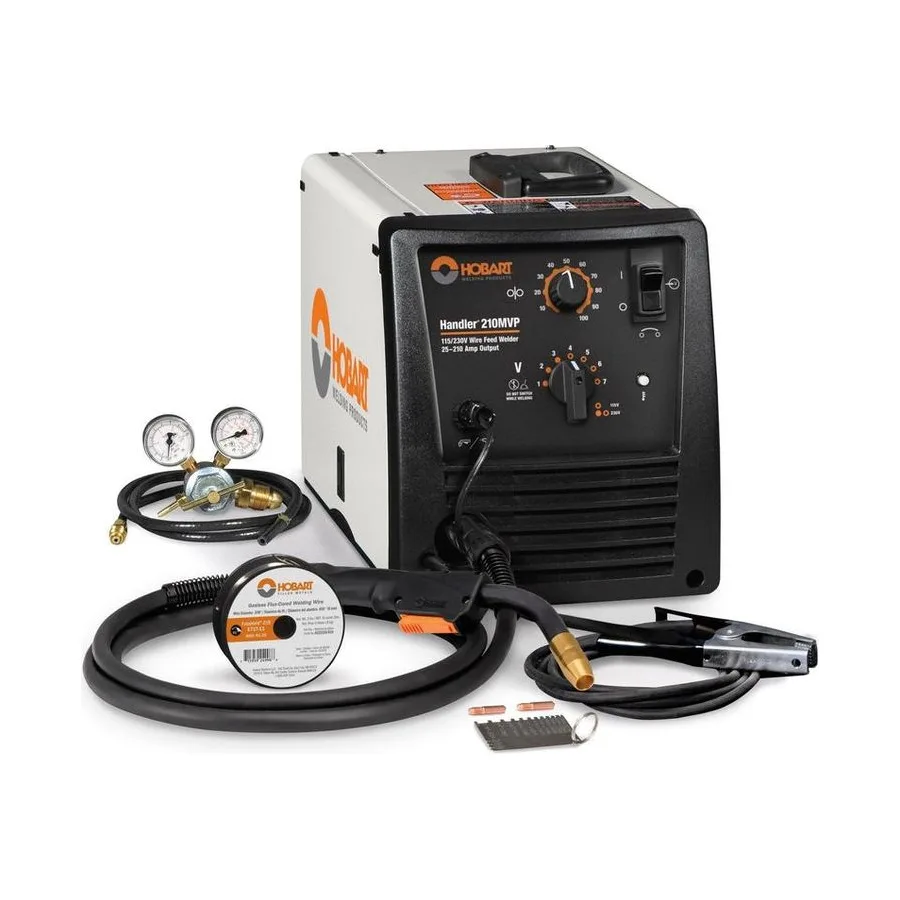
What owners rate it on
What owners do with it
Input power14 owners said
240V outlet36%
Both 120V and 240V29%
120V outlet21%
Generator14%
Thickest material welded14 owners said
1/8" to 1/4"50%
1/4" to 1/2"43%
Under 1/8"7%
How it is used21 owners said
Hobby and home62%
Paid work19%
Auto and fab19%
Process used14 owners said
Flux core50%
MIG with gas43%
Aluminum7%
Specs
What it does
- Amperage
- 25-140A (120V), 25-210A (240V)
- Duty cycle
- 90A at 20% (120V), 150A at 30% (240V)
- Thickest steel
- 3/8"
The machine
- Weight
- 79 lb
- Warranty
- 5/3/1 years 5 years on the transformer, stabilizers and main rectifiers; 3 years on PC boards and drive systems; 1 year on the gun.
Prices
54 owner reviews
For 110 fluxcore I just welded 1/8th inch plate with the heat at 6 and feed at 40. Worked pretty good.
Yes,, the whip is cheap in the hand. That being said, it has not failed me yet.
The only thing I don't like about mine is the mig gun stinger itself; I find it flimsy and low quality. I welded in the trade for years and I'm use to just better quality. I did some looking and there are really no aftermarket options like with a Miller and Lincoln. Other than that, it's a great machine.
$600 bucks? Whfen did you purchase it? I have had mine for a long time, at least 10 years, I paid around 8/900. Today I think they are 11/1200. Last week my 110 volt side shit the bed. I repleaced the circuit board from ebay. 350 for just the board.
I just got one of these I'll say this my forney 140 will weld 1/8 on number 3 out of 4 no problem,this welder needs to be turned all the way up on number 7 to penetrate 1/8 on 115v,imo id use the 115v for sheet or exhaust and run it on 220 for anything beyond that
I just opened and finally tried it. It's a big improvement over my Hobart Handler 210 although the Hobart was a good starter machine. LOVE IT so far. Looking forward to doing more with it.
I just got this welder, i used the 16 gauge settings and blew hole through mine too..looks like the recommended settings are too high
I love my Miller 211 or Hobart 210 MTV great machines ..210volt or 110volt just by changing the quick change plugs on the end included with the machines..I've pointed so many people in this direction only to be thanked over and over again! I myself don't bother with gas ..I like the fluxcore wire ..never had a problem with it in any of the welds i've done .. but then I'm 68 years old and have been welding since 12 .. just stay away from the off brands ..if ya want a good miller or hobart ..even a lincoln try the market place on facebook ..there are always some there at an affordable price ..best of luck ..god bless!
MIG (wire feed or GMAW) has limitations , Our (I have one) Hobart 210 is only recommended for welding up to 3/8" mild steel. but I can weld thicker because I know how to do it with gaps and multiple passes. What was impressing about the 210 was the duty cycle. During hours of non-stop welding with the amperage maxed out it never tripped out from overloading. The welding doesn't change, it will just shut down so I don't know what you're talking about there. but for safety critical welds from 1/2" to 1" I still use stick because our MIG can't handle it. Dirty Rust pitted metal is another reason to have stick around because MIG doesn't like dirty. Your review has some misinformation, Flux cored wire is exactly what it states, the flux is INSIDE not on the outside, and coating on the outside is to prevent rust on the wire. Flux cored is twice the price as solid wire and the color of solid wire is because it's micro plated with copper to prevent wire from rusting. There was a few other mistakes but trivial. The Hobart 210mvp is a good welder, and if you want to bump up the duty cycle the iornman 240 is better but a grand more. My stick AC/DC dinosaur and weighs as much has a 80% duty cycle, so when looking for a used stick don't pass up those old obsolete machines because they aren't pretty or light (which means cheap) and some cases get them free.
It has been a great welder so far, no issues. Definitely needs the 220v for thicker metal. Thanks for watching
I would 100% buy again. I run 100s of lbs through this machine a year
That is crazy the price has went up that much! It is still working great!
To answer your question with a question, what haven't I done with this welder? I've repaired: Dump bodies, snow plows, exhausts. I've built: homemade trailers, welding tables, carts, custom tools, ect. This is a SOLID machine, but understand its limitations. If you are looking for a high duty cycle, factory production machine, this obviously isn't it. However, if you are a diy, home bodied mechanic that wants to make a few bucks making welding small/medium welding repairs, or want to have the ability to build/fix anything of your own, this is a fantastic machine. This machine is well suited for mild still. I have also made some stainless steel welding repairs (with non stainless steel wire). No issues. Can't speak to the aluminum spool gun. This machine blows those cheap Chinese amazon crap welders out of the water. I do not recommend using the 110v Plug for general welding, as you won't have the power for thicker metals. The 110 plug does come in handy for situations where 230 isn't available. .030 Wire is what I recommend. Solid core wire with a 25/75 shielding gas makes for some beautiful looking welds. I likely have a few hundred hours on the machine. Nothing has failed, fried or broken. Absolutely solid machine. All I've replace are tips, and the copper gas cone (once).
The solid dots are only for 220v as well as the hollow dots,(range 1-7)But only the Hollow dots can be used for 120v, ( range 4-7). Great welder no problems as of yet!
I am very happy with it. The foot pedal that it comes with sucks, but works. I ended up buying the better foot pedal they offer.
I love my 210 MVP as well, dual voltage with a spool gun for a great price, super easy to learn on. I taught my wife to weld on it in under a couple hours.
Hobarts, at least the older models are durable, my Handler 125 is nearly 20yrs old, and after a few 100 lbs of flux core run through it, the fan is the only thing that is need of being replaced. I also have the 210 MVP and it has been issue free for the last 9yrs. For spray arc, I would opt for a Miller or ESAB if not wanting to spend for a Miller.
i have this same welder with a spool gun and am currently doing a boat transom build and soon building a mini jet. The welder is bad ass and i have found I don't need to spend the 2k or 3k on the big shop welders as this one can do everything. Since it is so portable I also have an extension off my welder generator in my truck and this allows me to go in the field and do boat repairs that would otherwise have to be done in the shop, just a little tarp to stop the wind and send it
iv built 3 trailers a welding bed for a f350 built 2 offroad rigs an its my go to welder iv had mine since 2017
To keep it short, its done everything I've asked and more. I would buy this welder again in a heart beat. Only annoyance, on larger jobs you hit the duty cycle and have to let the machine recoup for 10 minutes.
I've had one for a few years now. Bought it after hearing Jody (Welding Tips and Tricks) recommended it. I've used it quite a bit, and it's a great welder. I do agree with your complaints. Factory lead is too short, ground is too short. It weighs a ton, and I wish the voltage control was infinite. Other than that it's reliable, welds great, and is one of the best deals on the market! Runs great off of my predator 9000 generator too
I run a 210mvp. Got it and spool gun on a Black Friday deal about 4 years ago. You can get one now for 1099.00 at TSC. USAWELDS/HTP has 15’ guns with flex necks for 135.00. Great addition! I removed my short ground and just added a 15’ cable a little thicker with a quick disconnect and a brass clamp. I run some .045 flux core through mine allot. The thicker ground made huge difference. Now I’m also carrying a Everlast MTS251si welder on rig. But the Hobart gets used all the time. And yes it’s heavy!!😮
Yes I do. It's been a great solid machine for the past six years. I often weld on 1/4 in. steel with no complains.👍
Thanks for the comment Darrell. What I like is the versatility between 115 and 230. It's saved me many times over the years. If I was doing production work, I would absolutely invest in a commercial grade unit. I would really like to buy a Tig welder one day. Just can't justify the purchase at this point in time. l'll check out Jimbo
This is a great welder I use mine all the time and have had it for 3 years no issues. I've built a 14k trailer with this, repaired other trailers, patch panels in old rusted trucks etc. It can literally do anything you need it to.
I have had good luck with this 210 2 years now
The 115V is good for portability. You can weld on a mountain with a relatively small generator.
I've had this welder for a few months. I'd never welded before I bought it. After a couple of days welding scraps to practice I was asked to fabricate/weld up a pair of custom sunburst raings on a historic home. Using only flux-core wire and welding outside , I found the machine and the learning curve to be excellent, and the railing was impressive when completed. Now, it's winter and nasty outside and I have been asked to make another pair of custom railings for the back of the house. Just picked up a bottle of 75/25 and some solid wire and I'm looking forward to learning the new process, hopefully with much cleaner welds and less splatter, smoke, and post-weld clean-up(especially since I'll be working inside the client's finished basement with hardwood floors, etc). I love the welder as is, but would love it even more if they could shave off 30-40 pounds! I don't have a shop, so moving this beast is a very unpleasant task.
I have both and can say from my experience the Hobart 210 mvp burns much hotter. Its a much heavier duty machine. But weights like tank not portable. The titanium 200 is a feather and versatile . I like both.
Mine quit welding on the 220v side- after the first roll of wire ....
I use to have one then upgraded to the 210 mvp I only use it on 230 v. I love mine, I got the Hobart tig welder also and plasma. I know it was just a test but in a real project I would tack all four corners first before welding tube. Practice makes perfect 👍🏽
It’s a great machine. Worth the money for sure
yeah i think so. To me this welder has the power to weld anything you may come across at home.
Not to mention .035 wire if your welding thicker metal
I actually figured it out that the wire I was actually using was fluxcore (came with it) - I changed the polarity and it seems to be much better
I 100% agree with you. This machine keeps impressing me every time I use it.
You can melt some serious metal with the 210mvp. I have both and the Ironman obviously has more amps and higher duty cycle but the MVP offers portability and dual voltage. Unless you really need the higher amps, the 210mvp is the one you want. Can’t go wrong with Hobart Migs. They have dependable transformer design versus Miller and Lincoln garbage inverter designs. You throw those away when they go pop!
@TheOffRoadCorner the torch does get alot of spatter in it because it is small. I use spatter spray which does help a little. I also have a round file I use to clean it out while I am welding.
I trust this weld can take care of that trailer. 1/4” won’t be a problem for this welder. It’s a great machine and I would buy it again.
My test pieces were 1/4". Machine wasn't even maxxed out either. On the 030 pulse program it tops out at about 175-180A IIRC, a good bit lower than it's 200A max (which is attainable on other programs or on manual mode up to 220A for a short time). The key for it working so well, is in the name, the "pulse". The peak pulse is equivalent to 300A, but you don't see this on the display nor on an ammeter because it's stupid fast, something like 1/200th of a second.
I've found that chart to be a bit conservative, I'm not sure why, perhaps it was written with 230V input. I've done a fair bit of testing with a fluke multimeter hooked up to the terminals while welding and recording the voltage and it's always higher than the chart would suggest. When I first tried spraying with .030 at about 460 IPM I'd hooked the meter up and was recording around 23.5-24 volts which should've been high enough, but just barely. I do think you're right, I suspect as I up the wire speed high enough to get the feed rate and amperage to spray my voltage is dropping hard causing the arc to be unstable. I did get a stable spray with no popping or spatter for a few inches today though with .030 and around 450 IPM, it did start popping again towards the end, but they were a little less frequent and I could hear a consistent spray hiss. Not sure why it went a little better today, I was back above 240 at the plug today, though only at 242, I'd had the gas a bit lower today, but I can't why that would enable a more stable spray. I cut and etched it but I'd inadvertently left a gap when tacking so it's hard to say how much of the penetration is due to that. eTCH 3.jpg (23.42 KiB) Viewed 8585 times I wish I had the budget for a machine like that, I was really surprised just how much penetration you had with pulse spray, especially being a 200 amp machine, was that 3/16 or 1/4 ? larger transformer machines and especially inverters seem to have less of a voltage drop at high amperage. Your machine just gives you a lot more control of how the arc behaves regardless of things like wire size and voltage drop.
As a certified welder over 20 years I have this welder in my garage. I have welded everything from car sheetmetal to 3/8 thick metal with no problem at all. I love this machine and have made good side money with it. Would not pay the extra money for a Miller. It is basically the same and owned by them.
I don't do production work, not yet anyways, I agree that it would be ill suited for heavy spray because of the duty cycle, and I do intend to eventually upgrade to a larger machine. But I still wanted to get the most out of 210 amps I could and take advantage of the potentially greater penetration of spray and dual shield over short circuit on 1/4 plate. I've never even hit thermal cut off even maxed out with what I do, so If I could attain spray at around 150-170 amps with the gas it would be plenty usable for me. But I'm still not advocating for trying to spray with a machine my size, just sharing my experience. There isn't as much good info available on the performance of machines under 250 amps as there is for machines over it. I'd assumed .035 dual shield would've been the way to go on 3/16 to 3/8 plate with my machine, but I found the penetration while adequate to be less than I expected, and .045 may have been the way to go. I welcome all advice, but I'm also just sharing what I've seen so people can make their own conclusions.
Well, just finished up playing around today, I'm pretty exhausted in all honesty. I think I got a little burned through my shirt First a couple disclaimers, I am a terrible mig welder, I've not had a single mig class nor any training/job experience using one. Try not to get nausious when you see my welds . Second, my mains voltage is usually 10-15 volts higher than it was today, that may have influenced the results a small bit. I turned the voltage all the way up for all tests, and I was using .030 wire on 3/8 plate, I did my first fillet joint with around 385-400 IPM, and it was acting as if my wire speed was simply too low, it was a very quiet, spatter free hiss, but I was getting big globs dripping off my wire into the puddle and I was burning back relatively close to the nozzle, however the result looked a spray bead that was a little on the cold side. I did another plate at around 460 IPM that moved me away from the globs into a very hot short spray looking arc, although It was very very spattery and loud, short circuit transfer in my experience isn't even remotely as hot or bright as this was. I'd set my shade to 12, and when I'd backed down to short circuit settings later I could barely see the arc for comparison. I'd actually stabilized for a couple seconds towards the end once I increased my travel speed significantly, although it didn't quite wet in enough towards the end due to it. While I didn't take pictures, once I got to around 545 IPM I noticed I was getting a tiny ridge down the center and decided that was simply as high as there was any point going with wire speed. I'd also forgot to take a picture, but it still looked relatively flat and spray like. I played around fine tuning the settings, but never quite got a stable crackle and pop free arc, so I decided my machine just barely didn't have the voltage to fully stabilize spray arc with .030 on 92/8 gas. So I grabbed the little .025 roll of L-56 I had laying around. I had no idea if spraying with .025 would be of any use at all, but I figured If I could get a very stable spray, I could etch and compare both the .030 samples and the .025 to verify I was getting any spray with .030. Now I was definitely into a very stable spray, at 500 IPM I had like a 1/4-3/8 arc at the end of my wire It didn't burn back into the contact tip, but the second I let off the trigger it would burn right up to the tip of it. Once I f igured out stickout a little bit better, I was able to get a stable arc with zero popping or cracking noises up to around 615 IPM. Past that it would start behaving similar to the .030 with spatter and noise. As you can see I was definitely into a very stable spray arc with .025. Cutting and etching several pieces will follow soon. As I just got my tax refund and because it's only 9 dollars a month to rent, I might follow Oscar's lead and pick up an Oxygen Cylinder and introduce a small percentage of oxygen into the blend with a Y adapter. I need a torch anway
Worm tracks were a problem, I do plan to eventually try with lower voltage, I wouldn't attempt to use it on anything important, although it seemed very strong, I just wanted to see if it would actually run or just glob up cold metal. I'm actually thinking about getting a tank of pure Co2 for dual shield use, I could use the extra heat and from what I understand it makes it a lot less fussy.
I thought people might be interested in the results attempting spray transfer and using gas shielded fluxcore in a 210 amp class machine, so I decided I'd post about it. I'm always looking to become familiar with new processes and expand the capabilities of my welder and I although I've read more than enough to make me realize it wasn't optimal for spray transfer I've always wanted to give it a try, watching Jody's video's I also realized perhaps FCAW-G might be a pretty decent substitute as well. I made a bit of a trip to the largest welding store around me and to my surprise they had .035 Outershield 71M on hand, I immediately bought a roll, as soon as I got home I threw it into my welder, using 75/25 I spent several hours welding coupons and cutting and etching some. Although they still seemed plenty strong bending them in a vice, I noticed every single sample I cut open had a small slag inclusion at the very root of the weld, I tried numerous settings and gun angles, but while It didn't seem to get much worse no matter what I did, It didn't go away either. That being said the deposition rate was incredible, especially when upwards of 500 IPM It felt like I was just flying along. I was able to go up to nearly 600 IPM before I started having issues wetting in the toes of the weld. I suspect It could handle .045 dual shield just fine, and it might get better fusion that way as well, though I don't have the drive roll and liner to try it. I'd burned up close to 500 PSI of gas just experimenting that day however, and I realized I'd go through the rest of my 125CF tank a whole lot faster than I thought running the flow rate FCAW-G requires especially outside and I'd probably go through that spool of wire faster than I'd expect too. So I found myself heading back to the store to ask about renting a bottle of spray gas, I just had to settle my curiousity So I get there and a 380CF cylinder of 95/5 was only 60 dollars out the door and about 9 dollars at the end of each month. Unfortunately after paying they realized they didn't currently actually have any 95/5 on hand. They offered me a 92/8 Ar/Co2 tank instead of I wanted it, and he mentioned he would credit my account for the inconvenience, so I decided to take it as I figured it would also work for short circuit work on thinner stuff and possible better than 75/25 for sheet metal. I still had the .035 Outershield in the welder and I figured there was no harm in running a few beads with the new gas before I swapped over to .030 hardwire. I figured my machine would spray .035 FCAW-G at lower wire speed It would sure as hell spray on 92/8 although I expected a poor weld as a result of using the wrong gas. I was able to scrounge up some 3/8 plate, cranked the voltage to max, set the wire speed to about 475IPM, set about 1/2 stickout and ran a bead, to my surprise it actually came out looking nice and hot even showing some surface worm tracks from the voltage being too high, which made sense as other MFG's wire that may be rated to run on both 75/25 and 90/10 suggest decreasing the voltage as much as 2-3 volts when running 90/10. I welded up a couple more dirty pieces of 3/8 I had laying around and decided to clamp them in the vice, put my 2 foot pipe wrench on them and see how easily they broke. I'm a relatively strong guy, I weigh about 215 and while I'm not quite as strong now, I used be able to get a few chinups with 135 chained on, but It took most my strength to break the first weld far more than it would've taken to simply bend a 1/4 plate over, in fact I thought i'd broke the vice, and it still took a good bit of force to finish breaking the weld. On the second plate I had to brace against the table to avoid tipping it over, and didn't dare trying any harder for fear of breaking my vise. Since it was after midnight I figured i'd swap in the .030, try it so I didn't lay awake at night wondering and then go to bed. I scrounged through all my scrap some more, and found some 1/4 plate that hadn't been welded on enough I could use it. it wasn't very clean but I didn't care. With .030 E70s-6, at around 385 IPM and under I got a very quiet l spray arc type sound, but I was getting very large globs coming off the wire, I had a pretty large arc gap and I suspect my wire speed was simply too low. When I went above 400 IPM and on, I got what appears to be pinching of the wire and a short arc between the puddle and wire, I've not ran spray transfer before, but It looked pretty similar to what I've seen in videos and heard described, it looked like I could see some tiny droplets in the arc. It was VERY hot I could feel the heat and my gloves felt like I was running FCAW, the bead was very flat and fluid, but I was getting spatter, loud popping and crackling, and a very violent sounding arc. Now this was dirty metal, and it did seem to quite down some on slightly cleaner pieces, and I could hear a hiss in bectwen all the popping and crackling. I'm not sure if I was rapidly transitioning back and forth between spray and short circuit, If I was in a very hot short circuit mode, or if I was actually spraying, although the bead resembled a flat spray arc weld. I tried to break a 1/4 T joint I welded on one side, and I simple bent the plate itself to the point I couldn't go any further without hitting the vice. I did break a 3/8 T joint without too much trouble but it was absolutely filthy, scaly rusted steel. Then I grabbed some 16 gauge sheet metal, which I know to some of you is practically plate and you can weld it no trouble even with SMAW, but I find with my tapped machine, if I set it low enough not to blow through with .030 wire I glob up metal. However with this gas I was able to get a very smooth arc and beautiful bead, just shy of full penetration without too much trouble. I'm going to get some steel as clean as I possible can tomorrow and experiment some more as well as doing some cut and etching, whatever transfer method I'm actually in, it is plenty hot, looks like its digging deep and is quite usable. but only cutting and etching will show just what kind of penetration I'm getting. I will update this post, hopefully with some pictures when I do. I welcome any suggestions, but I also wanted to share my experiences for anyone with a similar machine.
The welder has been holding up great. I’m glad I bought it. I think this welder has plenty of power for 3/16 and 1/4” thick steel. The only I would suggest getting Ironman 230 over this welder would be if you need more duty cycle or any kind of production work with it. I built a 3/16” steel bumper for my jeep with this welder and it had no problems what’s so ever. If I was doing that everyday I’d probably move up to the 230.
It’s been a great welder and I’m glad I bought it. No regrets
My handler has 5 years on it today it stopped feeding and was back burning tips the drive roller wired but the shaft has play , so it doesn't feed right ... that fucking drive motor unit is $200 that's 1/3 the cost if a brand new refurb model ... most other units that part is about $70 .
I have a hobart 210 handler best welder iv owned except for my tig welder
Its a great welder had mine for a few years now. Definitely play with your speeds and voltage. 3/8 no problem struggled on 1/2" had to do multiple passes. A tip for ya the small the wire the less voltage needed. When im doing 20gage i run .024 And building jeeps as and trailers .030 or .035 The same company owns both miller and Hobart. My plugs say Miller.
I bought a Hobart handler 210 a couple years ago and I love it. It was a few hundred dollars less than the Miller and both are built by the same company in the same factory. I have built a bunch of stuff with it and it welds 3/8" steel without skipping a beat.
lol.. Al inn Lldm... to funny. Anyways, I have the same welder. I did a tri link stretch in the rear of my TJ a few yrs back and the welds held wonderfully. Only two bead techniques I feel work. Cursive E's and straight push. Be sure to run it as hot or a little hotter than you think you'll need and practice practice practice. It isn't all about what it looks like and don't get into the rut of making them look like tig welds. The strongest MIG welds are straight pushes (not the prettiest). After that's mastered, you can play with e's but stay on the puddle and keep it moving. You want a hot bacon sizzle with minimal splatter. A hot bacon with a lot of splatter just as bad as a low bacon sound and splatter. Practice on scrap, cut, dye, and look at your penetration.. Once your good at it then you're ready to go. A great 5 part video is "the basics of Mig welding" check it out. I'm about to start my SuperDuty 60 front stretch and my Sterling 10.5 rear.. Lots of Artec stuff....
You won't go wrong with a Hobart. I've been using a handler 210 for 10 years now and have had no problems with it. Only had to replace the work clamp after a few years.
Review videos
 Hobart handler 210mvp 2 year reviewJan 26, 2023 · YouTube ↗
 Hobart Handler 210 MVP Welder Review | My Thoughts After 6 MonthsOct 11, 2019 · YouTube ↗
 Hobart Handler 210 MVP Review 2020 - The Best Welder For The Money Hands DownFeb 19, 2020 · YouTube ↗
 Hobart Handler 210 MVP Review - The Best Welder For The Money Hands DownMar 23, 2018 · YouTube ↗
 Hobart 210 MVP 10 year overviewJul 25, 2022 · YouTube ↗
 Hobart Handler 210MVP Product DemonstrationAug 16, 2011 · YouTube ↗